Join us for Cooking with COLE!
📍 Location:
1720 W Locust St.
Milwaukee, WI 53206
📅 Dates:
August 3 at 2PM
August 31 at 2PM
September 14 at 5PM
September 28 at 5PM
October 12 at 5PM
October 26 at 5PM
📞 Any questions? Contact Shy at 262-420-3799

Past Events
COLE Action Alert (January 2025)
Call or email your state senator and representative and ask them to co-sponsor LRB 4174, the Lead Inspection Act!
Wisconsin law currently blocks local governments from proactively inspecting rental properties for lead hazards—meaning the local governments often discover dangerous lead exposure only after children are poisoned. Instead of preventing harm, we wait for blood tests to reveal it.
As the Milwaukee Journal Sentinel reported in 2023, “Maryland took strong steps to cut lead exposure. Wisconsin bans them.” Restoring local inspection authority would allow communities to use proven, effective strategies that other states have used to dramatically reduce childhood lead poisoning.
LRB‑4174, the Lead Inspection Act, would lift these restrictions and allow local governments to run and fund proactive rental inspection programs that identify and fix peeling and chipping lead paint before it harms children.
Take action today. Call or email your state senator and representative and ask them to co-sponsor LRB 4174.
_________________________________________________________________________
Sample message:
Hello,
My name is [name], and I live at [address]. I am asking you to co-sponsor LRB-4174, the Lead Inspection Act! This bill would restore the ability of local governments to run and fund rental inspection programs to prevent childhood lead poisoning. Jurisdictions in other states have significantly reduced childhood lead poisoning by establishing proactive rental inspection programs that find chipping and peeling lead paint before kids are poisoned.
Because rental inspection programs are blocked by state law, local governments typically only find lead hazards after kids are poisoned, harming their brain development and robbing them of their full potential.
[Optional: add your personal connection to this issue]
Please help prevent childhood lead poisoning by co-sponsoring LRB-4174.
Sincerely,
[name]
_________________________________________________________________________
Removing Statutory Barriers to Effective Lead Poisoning Prevention Policies
Background:
- Lead is a neurotoxin, and children exposed to lead may suffer from: lowered IQs; damage to the brain and nervous system; learning and behavioral difficulties; slowed growth; hearing problems; and headaches.[1] Other symptoms may occur in exposed adults
- There is NO safe level of lead exposure.
- In Milwaukee, 71% of severely lead-poisoned children (BLL≥15µg/dL) tested between 2018 and 2022, lived in rental housing units.[2]
- The most effective policies for reducing levels of childhood lead poisoning require registration and inspection/lead testing of rental units before they are rented to tenants. Other jurisdictions have dramatically reduced levels of childhood lead poisoning by requiring registration and inspection, including proactive lead testing of rental units before they may be rented to tenants.
The Problem:
The Wisconsin Statutes effectively prohibit the adoption of such common-sense policies by local governments in Wisconsin. Wis. Stat. § 66.0104, created by 2011 Wis. Act 108, and amended three times in the 2013, 2015, and 2017 legislative sessions,[3] prohibits the adoption of such policies by local governments. The statute:
- bans ordinances that “require a rental property or rental unit to be certified, registered, or licensed,” except for registration programs that collect only the name and contact information of the landlord, and strictly limits registration fees, except for first-class cities. Wis. Stat. § 66.0104(2)(e)4.
- prohibits municipal ordinances that require that a rental property or rental unit be inspected, except upon a complaint, under special inspection warrants, or as permitted by a limited exception set forth in the statute which permits creation of targeted rental inspection programs (TRIP). Wis. Stat. § 66.0104(2)(e)1. & 1m.
- strictly limits inspection fees charged by local governments, so that creating a TRIP, particularly one that includes lead screening inspections, imposes a significant financial burden on the municipality. Wis. Stat. § 66.0104(2)(e)2.a.
- prohibits municipalities from imposing occupancy or transfer of tenancy fee on a rental unit.” Wis. Stat. § 66.0104(2)(f).
The Solution:
LRB 4174, the Lead Inspection Act, would remove these barriers to rental inspection programs and would go a long way to reducing childhood lead poisoning in Wisconsin.
[1] U.S. EPA, What are some of the health effects of lead?, https://www.epa.gov/lead/what-are-some-health-effects-lead (last visited January 29, 2025).
[2] Milwaukee Health Department. internal analysis or data from the Healthy Homes and Lead Poisoning Surveillance System and City of Milwaukee Property Records, 2025.
[3] See, 2013 Wis. Act 76, §§ 1-4; 2015 Wis. Act 176, §§ 8-11; 2017 Wis. Act 317, §§ 7-17.

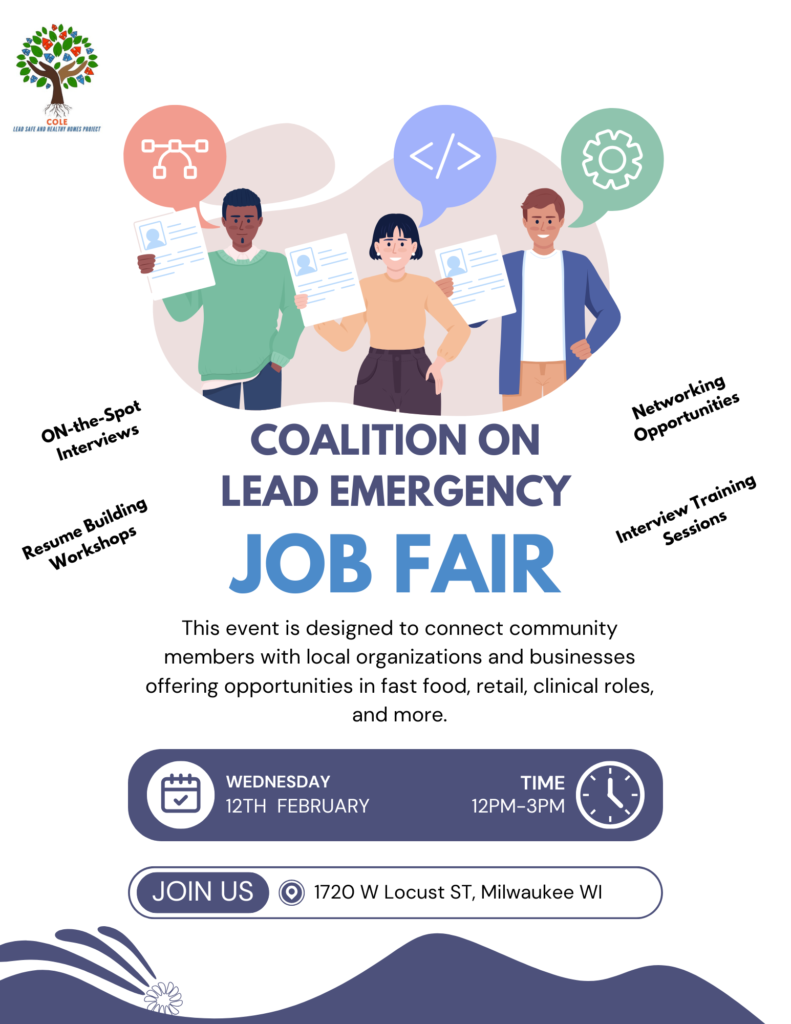
Notice of community event: Please Join us for the COLE Job Fair! Please see the flyer attached below for details.)
Posted February 1st, 2024
Notice of community event: Please Join us for the Mom 2 mom support group (Please see the flyer attached below for details.)

Posted February 1st, 2024
Notice of community event: Please Join us for the Focus on fathers support group(Please see the flyer attached below for details.)

Posted February 1st, 2024
Notice of community evet: Please Join us for the neighborhood lead town hall meeting. (Please see the flyer attached below for more details.)

Posted October 25, 2024
Please Join us for the neighborhood lead town hall meeting. (Please see the flyer attached below for details.)

Posted October 25, 2024
Please Join us for the COLE Cooking classes and Coat Drive. (Please see the flyer attached below for details.)

Posted September 19, 2024

Posted March 11, 2024
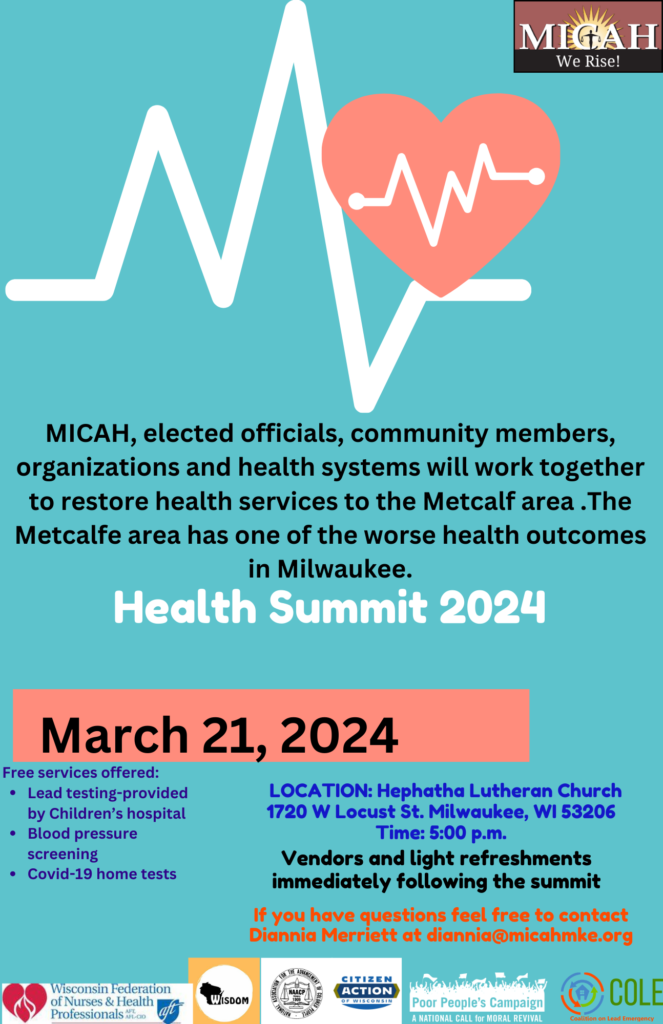
Please Join us on Thursday, March 21st, at 5 P.M. for the MICAH Health Summit. (Please see the flyer attached below.)
Please Join us Friday, 12/1/2023, 3P.M. at a Press Conference to Keep Next Door Pediatrics Open!
Please Join us Friday, 12/1, P.M. at Children’s Wisconsin Corporate at 999 N 92nd St. Milwaukee, WI 53226. This rally is to support Next Door Pediatrics clinic in Metcalf Park and keep it open for the community. Please see the flyer below for more information.

Posted June 30, 2023
Please Join us Monday, 7/24, 6P.M. at the South Side Town Hall!
Milwaukee Water Works plans to hold a series of town hall meetings this summer to invite residents to help us improve the plan. MWW hopes to launch the Equity Prioritization Plan this fall. See poster and click the heading for this post for more information.
Join us at the next in-person meeting:
Social Media Graphics and Flyers for APRA Input Sessions
- South Side Town Hall: July 24, 2023, 6:00pm at the Mitchell St. Library, 906 W. Historic Mitchell St.

Posted February 8, 2023
Opportunities to Engage with ARPA Funding Allocation Task Force Public Input
Join us at the next in-person meeting:
- Saturday, February 11, 10:00 a.m.-noon – Mitchell Street Library, 906 W. Historic Mitchell St. Bilingual Spanish Session
Attend a Virtual ARPA Meeting:
- Wednesday, February 22, 5:30-7:30p.m.
Take the online survey now:


COLE Talking Points for ARPA Funding
COLE is seeking $5 million of ARPA funding as a seed investment for the establishment of a Lead-Free and Healthy Homes Fund which we anticipate growing to $100 million over the next several years. Without this ARPA funding, it will be an enormous challenge for COLE to create such a fund.
Please see the attached for the excellent Talking Points that Tony has put together for those who want to offer testimony. Your presence is vital whether you speak or not. If you do not choose to offer testimony, please stand in support when someone else is offering favorable testimony.
Posted February 3, 2023
Please Join us Saturday, 2/4, 10:00 a.m. at the Riverworks ARPA Hearing!
We are hoping that you will be able to attend and encourage others to attend the ARPA Funding Allocation Task Force Public Input meeting this Saturday, February 4, from 10:00 a.m. – 12 noon, at Riverworks, 526 E. Concordia Avenue.
COLE is seeking $5 million of ARPA funding as a seed investment for the establishment of a Lead-Free and Healthy Homes Fund which we anticipate growing to $100 million over the next several years. Without this ARPA funding, it will be an enormous challenge for COLE to create such a fund.
Please see the attached for the excellent Talking Points that Tony has put together for those who want to offer testimony. Your presence is vital whether you speak or not. If you do not choose to offer testimony, please stand in support when someone else is offering favorable testimony.
Posted April 26, 2021
COLE’S ASKS FOR THE WISCONSIN BIENNIAL BUDGET 2021-2023
EXECUTIVE SUMMARY of Requests from COLE (Coalition on Lead Emergency)
Whereas, lead poisoning at or above 5 micrograms of lead per deciliter (5μg/dL) of blood can cause permanent cognitive damage, behavioral problems, higher school suspension rates, health issues, and increased incarceration for violent crimes;
Whereas, lead poisoning in children costs WI taxpayers $7 billion in costs for medical treatments, special education, and crime and juvenile delinquency;
Whereas, lead exposure to children ages 1-6 is mainly due to interior and exterior dust from deteriorating lead-based paint (in homes built before 1978 or earlier), while lead exposure to children under age 1 can have especially high contributions from lead pipes (“service lines”) and other lead-containing plumbing that carries drinking water; and
Whereas, lead-poisoned children are found in every Wisconsin county
Therefore, the Coalition on Lead Emergency (COLE) requests the following items be included in the Wisconsin Biennial Budget for 2021–2023:
1) $20.3 million over the biennium for LOCAL HEALTH DEPARTMENTS – to increase current interventions for children and families:
- $9.5 million to increase testing Wisconsin children at risk for lead poisoning;
- $900,000 additional to educate parents about lead hazards and lead poisoning prevention;
- $9.9 million increase over the biennium to expand services in the Birth to 3 Program to support education and development of children affected by lead poisoning.
2) $23.8 million over the biennium to REDUCE LEAD POISONING BY PAINT – and add $20 million in federal matching funds:
- $11.8 million additional funding for local health departments to conduct lead hazard investigations and issue lead abatement orders for homes endangering children;
- At least $8 million as a state revenue match to leverage an additional $20 million in federal dollars (CHIP) for the Lead-Safe Homes program, to fund remediation of deteriorating lead-based paint hazards and increase associated workforce development;
- $4 million plus 1 position in ongoing funding for the Windows Plus Program, to fund remediation of friction surfaces that grind lead paint into dust (like windows).
3) At least $40 million over the biennium to REPLACE LEAD SERVICE LINES – to reduce the risk to children and especially to formula-fed newborns and infants.
CALL TO ACTION! (before October 27)
Posted 10/20/2020
$3.55 Million Needed to Assess Lead-Poisoned Children’s Homes
Please contact your alderperson and Mayor Barrett by October 27 – before the Common Council votes on the budget! Ask that $3.55 million be allocated to the Milwaukee Health Department to assess the homes of ALL children found to be lead poisoned in 2021. Currently a relatively high threshold of poisoning (20 mcg/dl) is required to trigger home assessment, but this misses about 1700 poisoned children every year. Please see COLE’s press release below.
Contact Mayor Barrett: mayor@milwaukee.gov, 414-286-2200
Find your Alderperson here or simply click on the picture of your Alderperson on the Common Council site and you will see their contact information.
Contacts: Richard Diaz, Chair, COLE, Richhard.diaz@gmail.com, 414-687-2030; Dennis Jacobsen, Chair, COLE Organizing Committee, lynnjake@sbcglobal.net, 414-395-6420
Milwaukee – COLE issues a correction to its October 1 press release regarding its 2021 Milwaukee Budget request. COLE now urges the Milwaukee Common Council and Mayor Barrett to increase the 2021 Milwaukee Health Department (MHD) budget by $3.55 million to provide funding for the MHD to conduct lead inspections and issue consequent abatement orders in the homes of Milwaukee children who are lead-poisoned at or above the threshold of 5 mcg/dl. The amount of $1.6 million stated earlier by the MHD was found by the MHD to be in error. That level ($1.6 million) would still leave about 1300 children poisoned in 2021 without the level of safety provided by a home assessment.
Currently, MHD resources are so limited that lead inspections are conducted only in the homes of children determined to be lead-poisoned at or above a relatively high threshold – 20 micrograms of lead per deciliter of blood (20 mcg/dl). This is only about 6% of those found to be poisoned.
However, 5 micrograms of lead per deciliter of blood (5 mcg/dl) is the level that defines a lead-poisoned child according to WI Statute 254.11(9) and CDC recommendations.
In 2019, only 115 cases in Milwaukee reached the high threshold of 20 mcg/dl. Consequently, the MHD inspected homes lived in and frequented by 140 children (some qualifying under other criteria) and abated155 homes. Screenshots of data provided by the MHD show that this high threshold meant that the homes of ~1745 children identified as lead-poisoned in 2019 were not inspected for sources of lead. (See MHD data below.)
*Venous highest blood lead test per child under 6 years (headings added by COLE for clarification)
| mcg/dl test results | # of individuals |
| 5-.9.9 | 1368* |
| 10-14.9 | 271* |
| 15-19.9 | 101* |
| 20-39.9 | 101* |
| 40 or Greater | 14* |
Highlighted in yellow are those children in 2019 whose elevated blood lead levels triggered attempts to assess their residences. Providing the resources needed to assess the homes of children poisoned at the level of 5 mcg/dl is a critical first step in triggering abatement, greater parental awareness, case monitoring, and inhibiting the continued poisoning of children within such households.
Therefore, COLE is requesting $3.55 million be allocated for the MHD budget to make such assessments possible.
Based on the 2019 data, a 5 mcg/dl threshold will trigger aggressive follow-up for 16 times the current number of lead-poisoned children. Therefore, in 10 years this program will have responded to ~17,450 poisoned children otherwise not included in lead inspection and lead abatement efforts. This program will also have removed a critical barrier – assessment needed to trigger abatement – to greatly increase the coterie of lead-abated properties in Milwaukee.
Recent research by Dr. Emily Lynch and her UWM colleague Dr. Helen Meier determined that being poor, non-white and a renter increases one’s likelihood of being lead poisoned. In recognition of the long-lasting stamp of racism on Milwaukee housing, COLE feels it is crucial that the Common Council and Mayor Barrett act now to remove lead hazards by enabling assessments at the lower threshold. COLE Chair Richard Diaz says, “While ‘the arc of the moral universe is long,’ it is up to us to make it ‘bend toward justice.’”
CoalitionOnLeadEmergency@gmail.com
####
The Coalition on Lead Emergency, COLE, wants all residents of Milwaukee, Wisconsin, to live in an environment where each known source of lead exposure is eliminated. Therefore, COLE is dedicated to creating a sustainable lead safe environment in Milwaukee by engaging a broad range of community partners. It is a collective of nonprofits, environmentalists, educators, doctors, community members and civic activists with three foci: education, workforce development and organizing.